

7 Designer Approved Travertine Coffee Tables That Never Go Out of Style
Updated October 2026
Few materials define the modern luxury interior like travertine. Earthy yet sculptural, refined yet raw, a travertine coffee table grounds a room with natural texture in a way few other pieces can.
Below are 7 of the most talked-about travertine coffee tables among designers, from collectible Italian vintage to accessible retail favorites. For each one we explain what makes it special, how to style it, and who it suits best.
We are Travertable, a stone atelier that cuts every table to order from natural travertine. Alongside each designer piece, we show the Travertable table closest in spirit. After the list, we share what we've learned from years of working with this stone: the questions you should ask any supplier before you buy a travertine table, whether from us or anyone else.
1. Angelo Mangiarotti Travertine Coffee Table (Vintage)
🗝 Design Origin: 1970s, Italy
💡 Why It Stands Out: Architectural precision, no hardware
💰 Price Range: $4,000–$12,000+ (vintage market)
A Gravity Defying Icon of Italian Design
Architect and designer Angelo Mangiarotti was known for material honesty and structural purity. His stone tables are assembled without hardware: each interlocking piece is held in place by weight and gravity alone, showing off the natural strength of the stone. It is furniture that respects physics as much as aesthetics.
Why Designers Love It
Timeless appeal: It appeals to vintage collectors and brutalism fans alike.
Collectible status: Original pieces have held and grown their value at auction and on platforms like 1stDibs.
Visual weight: It creates a strong focal point in open plan spaces, especially against minimalist backdrops.
How to Style It
Pair it with low profile seating such as a modular or curved bouclé sofa so the table reads as sculpture. Keep accessories minimal: one oversized ceramic bowl or a short stack of monochrome books. A high contrast rug (cream on dark, or the reverse) brings out the travertine's tonal variation.
Best in: brutalist lofts, gallery-like modernist apartments, and Mediterranean homes that celebrate texture.
Where to Source One
Authentic Mangiarotti pieces turn up on 1stDibs and at design auction houses such as Phillips and Wright. Expect to pay a collector's premium and check provenance carefully.


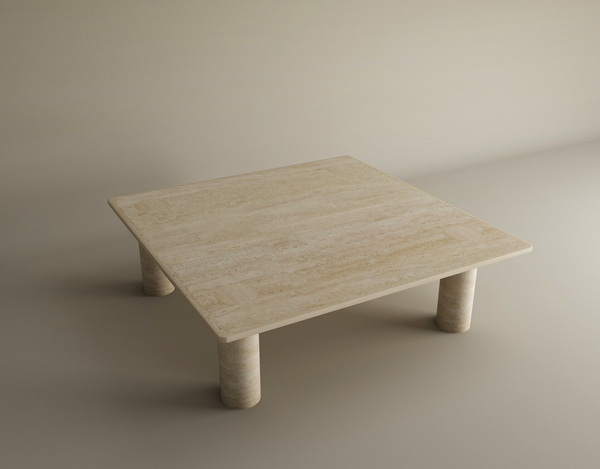
The Travertable Alternative
Square Travertine Coffee Table with Solid Cylindrical Base
The same architectural, stone-on-stone spirit, newly made: a square travertine top resting on four stone cylinders.
- 110 × 110 cm (43¼″), height 36 cm (14¼″)
- Vein-cut natural travertine, honed matte, hand-shaped bullnose edge
- Custom sizes and stones available
2. Anya Travertine Coffee Table – Anthropologie
🌿 Style Vibe: Modern organic
🪵 Materials: Travertine top, oak base
💰 Price: Around $1,000 (check retailer for current pricing)
The Anya bridges high design and everyday livability. A honed travertine top on a cylindrical bleached oak base captures the modern organic look, where sculptural form meets earthy warmth. Unlike colder minimalist designs, it feels inviting and grounded.
What Designers Love
Presence without heaviness: The cylindrical base gives it substance while keeping an airy, architectural feel.
Natural variation: Every top carries its own veining, so no two are identical.
Compact proportions: Its round format suits smaller seating areas and open plan spaces where sightlines matter.
How to Style It
Minimal Scandi: ivory bouclé armchairs, a jute or wool flatweave rug, matte ceramics.
Warm vintage modern: mid century leather seating, a sculptural floor lamp, a shag or quilted rug.
Contemporary maximalist: deep velvet sofas and graphic art, with the table as the neutral anchor.
Best for: style on a mid range budget, apartments that need a compact centerpiece, and anyone who wants the look without full custom pricing.


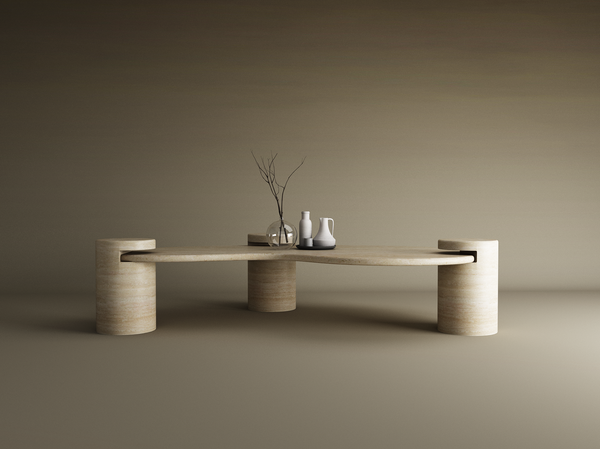
The Travertable Alternative
Wavy Travertine Coffee Table with Cylindrical Plinths
If the Anya's soft, organic mood is what draws you, this takes it further in all stone: a flowing freeform top that slots into cylindrical travertine plinths, with no sharp corners.
- Classic 135 × 75 cm or Grand 165 × 96 cm
- Vein-cut natural travertine, honed matte
- Two-level design for books and objects
3. Hollywood Hills Faux Travertine Table – Brigette Romanek (Crate & Barrel)
🛠 Material: Resin with a travertine-look finish
🎨 Designer: Brigette Romanek
🪑 Bonus: Built in storage cutout
Designed by Brigette Romanek, whose interiors are known for being both bold and livable, the Hollywood Hills Coffee Table captures a carved-stone look in resin with a travertine-like finish. Yes, it is faux, but it is a deliberate material choice rather than a cheap imitation.
What Makes It Work
Architectural shape: The angular cutout is striking and practical; use it for books, records, or simply as negative space.
Neutral finish: Works with dark moody palettes and bright neutrals alike.
Lightweight: Real stone tables often weigh several hundred pounds; resin is easy to move and forgiving in homes with kids or pets.
Real Talk: Is It Worth It?
If you want the look of sculpted stone in a lighter, lower-maintenance form, it hits a sweet spot, especially for young families and renters. If you want the cool touch, weight and natural veining of authentic travertine, resin cannot replace it.
Style It Like a Pro
Pair it with a chocolate, charcoal or camel velvet sofa to warm up the finish, add one low sculptural vase, and ground it with a natural jute or wool rug.


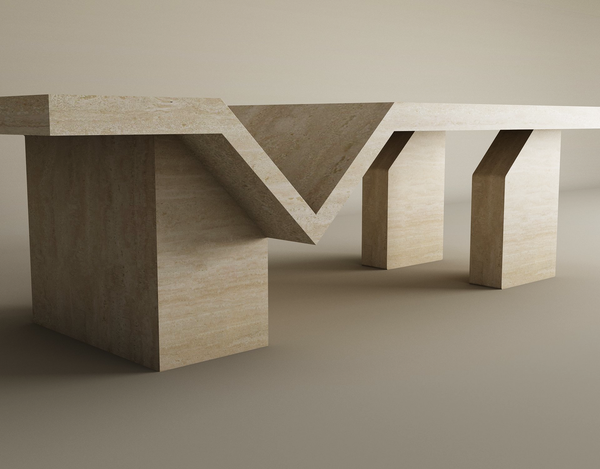
The Real Stone Alternative
Architectural Travertine Coffee Table with Sculptural Base
Love the sculptural, angular drama but want real stone instead of resin? This piece pairs a geometric travertine top with three carved stone supports: the same architectural attitude, in natural stone that will last for generations.
- 140 × 58 cm (55″ × 22¾″), height 36 cm
- Real vein-cut travertine, not faux or resin
- Honed matte finish, custom sizes available
4. Carve Nesting Travertine Tables – CB2 x Studio Anansi
🌀 Design Influence: 1970s Italian postmodernism
📐 Format: Fluted pedestal, nesting
💰 Price: Around $400–$500 each (check retailer)
The Carve Nesting Tables, a collaboration between CB2 and Brooklyn studio Studio Anansi, pair a minimalist slab top with a fluted pedestal base in natural, unfilled travertine. They are small, but the texture makes them read like sculpture.
Why They Work
Flexible: Layered together they form a low, dimensional centerpiece; separated, they become side tables around a sectional.
Fluted bases: They nod to classical columns with a modern edge.
Unfilled stone: The open pores give an honest, earthy texture. Note that unfilled travertine needs a little more care with spills and crumbs.
Design Pairing Ideas
Minimalist: clean lined seating and sculptural lighting. Tonal: bouclé, wool, white oak and ash. Collector: treat each table as a plinth for a handblown vase or an art book.


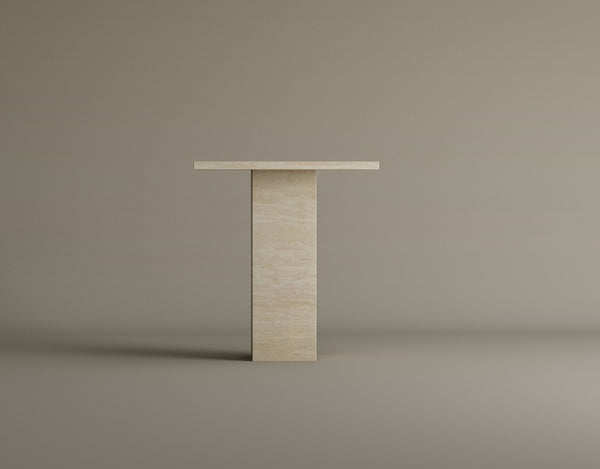
The Travertable Alternative
Monolith Elegance Travertine Side Table
For the same sculptural, plinth-like presence, this travertine block table works beside a sofa or, ordered as a pair or trio, as a modular centerpiece. We color-match every piece in the group so they read as one family.
- 45 × 45 cm, height 50 cm
- Vein-cut natural travertine, honed matte
- Order two or three for a nesting-style group
5. Enyo Travertine Coffee Table – CB2
🏛 Design Language: Brutalist meets luxury
🧱 Details: Monolithic slab, recessed base
💰 Price: Around $1,600 (check retailer)
Designed by Melbourne studio VUUE for CB2, the Enyo is unapologetically architectural. A travertine veneer over a composite core creates the look of a monolithic stone block that seems to hover just off the floor thanks to its recessed base.
What It Does Best
Visual gravity: Its low, long profile draws the eye without overwhelming the room.
Warm minimalism: Brutalist in shape, but the travertine veining keeps it inviting.
Large rooms: It fills the space in front of a wide sectional with substance.
✅ Ideal for: minimalist, Japandi and modern Mediterranean interiors, and large sectionals.
❌ Less ideal for: very tight rooms and homes where furniture needs to move often.
Styling Tips
Go low and wide: a long tray, large books or a horizontal floral arrangement rather than tall décor. Let it breathe: avoid crowding it with side tables or busy rugs. Add softness: linen, sheepskin and bouclé balance the weight.


The Natural Stone Alternative
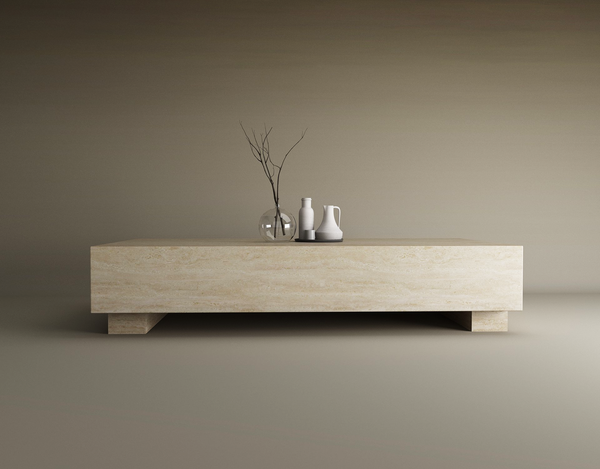
Rectangular Travertine Coffee Table with Hidden Base
The same floating-monolith effect, made with a full 2 cm vein-cut travertine slab instead of a thin veneer. The base is set back out of sight so the stone appears to hover, and it sits on concealed wheels, so even a heavy stone table can be moved for cleaning.
- 170 × 90 cm (67″ × 35½″), height 36 cm
- Premium 2 cm vein-cut travertine, honed matte
- Hidden base on wheels
6. Marin Oval Travertine Table – Lulu & Georgia
⚪ Silhouette: Soft oval
🌾 Materials: Travertine top, ash wood base
💰 Price: Around $1,200 (check retailer)
The Marin Oval Coffee Table is both refined and approachable. A rounded travertine top on a clean lined ash base makes it all about softness: soft color, soft shape, soft edges. In rooms full of layered neutrals and plush upholstery, it becomes a calm anchor that earns attention rather than demanding it.
What Makes It Work
Oval profile: No harsh corners, which suits tighter layouts and family homes.
Blonde ash base: Tonal continuity with the creamy stone.
Subtle texture: Visual depth without breaking the calm.
✅ Best for: California casual, new Mediterranean, Japandi and transitional interiors.
❌ Less ideal for: very formal or ornate rooms, where it may feel too simple.
Styling Tips
Keep accessories tonal: matte ceramics, sculptural wood, pale books. Add one low bowl or tray at the center, and don't over-style. The stone's grain is the point.


The Travertable Alternative
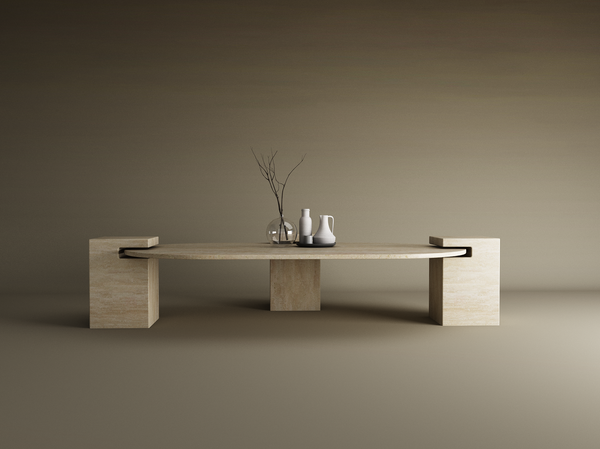
Oval Travertine Coffee Table with Square Base
The Marin's soft oval silhouette, made entirely of stone: a rounded travertine top on square travertine bases, with no wood and a more substantial, sculptural presence.
- 160 × 90 cm (63″ × 35½″), height 36 cm
- Vein-cut natural travertine, honed matte, hand-shaped bullnose edge
- Sized for larger sectionals; custom sizes available
7. Vintage Postmodern Travertine Tables
🔍 Where to Find: Chairish, 1stDibs, local dealers
📐 Shapes to Watch For: Waterfall, pedestal, brutalist blocks
Long before its current revival, travertine had a big moment in the 1970s and 1980s, especially in postmodern Italian and American design. Think bold lines, geometric forms and heavy materials: tables made to be sculpture.
Defining Features of the Era
- Chunky slabs with strong silhouettes
- Waterfall edges, where the stone flows over the sides
- Pedestal bases: square, cylindrical or zig zag
- Mixed materials such as travertine with glass or brass
How to Style One
Let it breathe: give it space and few accessories. Pair old with new: offset heavy stone with a curved bouclé sofa or slim legged chairs. Balance scale: if the table is low and blocky, draw the eye up with tall lighting or art.
Where to Source
- Chairish
- 1stDibs
- High end vintage dealers in major cities
- Estate sales and local marketplaces, if you're lucky
Prices range widely, from under $1,000 for a small unsigned piece to $12,000+ for named designer work.
Before You Buy Vintage
Repairs: Cracks are common in old stone. Check how they were fixed, not just whether they exist.
The underside: Look at how the top is reinforced. Many older tables have no backing at all, which matters if you plan to move it.
Thickness and weight: A suspiciously light piece may have a thin laminate or composite top rather than a real stone slab.
Delivery: Stone is heavy. Factor in freight and whether the seller crates it properly.


Prefer new stone over months of hunting? Our travertine coffee table collection includes chunky slabs, plinth bases and freeform shapes inspired by this era, each cut to order, with no old repairs and no surprises.
Comparison Chart: Designer Pieces vs. Travertable Alternatives
Retail prices are approximate. Check each retailer for current pricing and availability.
| Table | Style | Material | Approx. Price | Best For | Travertable Alternative |
|---|---|---|---|---|---|
| Angelo Mangiarotti (Vintage) | Architectural / Italian Modern | Natural stone | $4,000–$12,000+ | Collectors, design purists | Square Table, Cylindrical Base |
| Anya – Anthropologie | Modern Organic | Travertine + oak | ~$1,000 | Mid range budgets, compact rooms | Wavy Table, Cylindrical Plinths |
| Hollywood Hills – Romanek | Sculptural Contemporary | Resin (faux) | ~$1,000 | Families, renters | Architectural Table, Sculptural Base (real stone) |
| Carve Nesting – CB2 | Modular / Architectural | Unfilled travertine | ~$400–$500 each | Apartments, flexible layouts | Monolith Elegance Side Table |
| Enyo – CB2 | Brutalist Minimalism | Travertine veneer | ~$1,600 | Statement living rooms | Rectangular Table, Hidden Base (2 cm slab, on wheels) |
| Marin Oval – Lulu & Georgia | Soft Modern / Transitional | Travertine + ash | ~$1,200 | Neutral, calm interiors | Oval Table, Square Base |
| Vintage Postmodern | Bold / Eclectic | Natural stone | $800–$12,000+ | Treasure hunters | Full coffee table collection |
TL;DR – The Best Travertine Coffee Table For:
Iconic designer credit: Mangiarotti (vintage)
Budget and style: Anya by Anthropologie
Sculptural drama, kid-friendly: Hollywood Hills by Romanek
Modular function: Carve Nesting by CB2
Minimalist wow factor: Enyo by CB2
Soft tonal interiors: Marin Oval by Lulu & Georgia
Vein-cut natural stone, made to your size: Travertable
How to Choose a Travertine Coffee Table: What to Ask Your Supplier
You might buy from us or from another maker. Either way, two tables that are both called "travertine" can be worlds apart in quality, and you can't see most of the difference in a product photo. These are the questions we'd ask if we were buying, along with how we answer them at Travertable.
First, an honest truth from people who work with this stone every day: travertine is not the easiest material to make furniture from. It formed in layers around mineral springs, so it is naturally porous and full of small cavities, and a thin slab can crack if it's handled or supported badly. Travertine has become even more popular over the last five or six years, and plenty of stone is now being sold for furniture that was never really suited to it. That's exactly why the way a table is made matters so much.
1. Is it vein cut or cross cut? (The most important question)
Ask: "Which way was this slab cut from the block?"
Travertine forms in layers, a little like the rings of a tree. How a block is sliced decides what the stone looks like for the rest of its life:
- Vein cut slices across those layers, revealing long, linear veins that run through the slab like flowing stripes. The pattern is more consistent, more elegant and more architectural.
- Cross cut slices along the layers, giving a cloudy, mottled, more random look with fewer defined lines.
Both are real travertine. But the veins change everything about how a table looks. Within each cut there are also big differences in grade. Cheaper options include darker cross-cut stone, or vein-cut slabs with large holes that are filled afterward and show up as patchy spots.
There is plenty of travertine on the market, and much of it is perfectly good for floors or wall cladding. A floor tile is supported across its whole surface, while a tabletop is supported only at its base, so it has to be strong and free of big cavities and cracks. It's also the first thing everyone looks at. A lot of stone simply isn't good enough for that.
Our standard: We use premium ivory-white, vein-cut travertine, the most valuable grade available. Finding a good bundle of slabs isn't quick. We sometimes wait weeks for the right stone rather than compromise on a table.
2. Look at the veins, the veins, the veins
In our opinion, the veins are what make a travertine table beautiful. The more consistent they are, the better the table looks, whether the lines are straight and direct or softly wavy. Veins that flow evenly from one end of the top to the other make a table look calm and expensive. Broken, patchy or chaotic veining makes it look busy.
Which leads to the single best piece of advice in this guide.
Long story short: Ask your supplier to show you photos of the actual slabs before they cut them, and approve only if you love what you see. At Travertable this is standard policy: we always share slab options with you before we make a single cut.
3. How thick is the stone?
Ask: "What is the thickness of the actual stone slab, not including any backing?"
Always ask for the thickness of the stone itself. Thin stone layers (often called veneer) look the same in photos but are far more fragile and can't be repaired or refinished in the same way.
Our standard: We use a premium 2 cm thick travertine slab for our tabletops.
4. How is the tabletop reinforced?
Ask: "What's under the stone, and how is it attached?"
Because travertine is a fragile stone that can break, a well-made table never relies on the slab alone. What's underneath, and how it's bonded, decides whether your table survives delivery, a move, or years of daily life. Even the brand of adhesive matters, because a cheap glue can let go over time.
Our standard: We bond a 2 cm MDF reinforcement panel under every tabletop using premium silicone adhesive, and add an epoxy fillet along the underside for extra resistance. The result is a top that's far stronger than the stone on its own.
5. What are the holes filled with?
Ask: "Is the stone filled, and what is the filler made of?"
Travertine's natural pores are usually filled to make the surface smooth, practical and easier to clean. But what goes into those holes matters a lot. Some manufacturers use cement or a generic filler that doesn't match the stone, so it looks like patches or spots up close. Good filling is almost invisible. It keeps the natural look of the stone instead of fighting it.
Our standard: We developed our own filling recipe: a mixture of epoxy and mastic whose main ingredient is travertine dust from the stone itself. Because the filler is made of the same stone, it blends in naturally.
6. What edge profiles are available?
Most mass manufacturers offer only a straight edge, because it can be cut quickly by machine. Shaped edges like a bullnose (a fully rounded edge) are much harder. Shaping a rounded profile into a fragile, porous stone is a delicate process, and one mistake can destroy the whole tabletop. When a maker doesn't offer them, that's usually why.
Our standard: We offer a range of edge profiles, including bullnose. Our experienced artisans shape them by hand, cleanly and flawlessly.
7. Honed or polished?
A honed finish is smooth but unpolished, with a soft matte look. It's the most natural look for travertine, and it's what most of our clients choose. A polished finish is glossy and reflective. If you're not specifically after a shiny look, go for honed. If you do love gloss, ask your supplier for a polished finish.
8. Does the color suit your room?
Travertine comes in a surprisingly wide range of colors, from deep brown through warm beige and honey tones to almost white ivory. A color that looks perfect on a product page can feel very different next to your floor, sofa and walls. Compare samples or slab photos in your own room's light, and make sure the color matches your space.
9. Are there onyx inclusions?
Some travertine contains onyx-like inclusions: darker, crystalline areas that can look like dark spots, sometimes as big as your hand. These usually lower the grade of a slab, but not always. If the veining around them is beautiful and consistent, they can add character. Again, it comes back to the veins and to seeing the slab before it's cut.
10. Will the top and the bases match?
This is easy to miss. The tabletop and the bases are often cut from different blocks of stone, because a base needs a thick block while the top needs a wide, beautiful slab. Two blocks from the same quarry can still differ noticeably in tone. One can be slightly warmer, pinker or greyer than the other. On a coffee table you see top and base together all the time, so a mismatch in color is obvious and it can make the whole piece look cheap.
Ask how your supplier makes sure the base matches the top, and whether you can see both before production.
Our standard: We pick base stone specifically to match the color of your approved slab, and check top and bases side by side before finishing.
11. Be a little flexible on dimensions
Our advice may sound surprising: don't insist on exact dimensions. Natural slabs come in the sizes nature gives. Your supplier may find an exceptional slab, with perfect veins and perfect color, that's just a little shorter than the size you asked for. If you're rigid, you lose it to a few centimeters. Be ready for small changes in length, width or height in exchange for a far better stone.
12. Are you ready for the weight?
Natural stone is heavy, so be ready for a solid piece. As a rule of thumb, travertine weighs about:
| Measure | Metric | US |
|---|---|---|
| 2 cm slab, per square meter | ~55 kg per m² | ~120 lb per m² (~11 lb per sq ft) |
| Solid stone, per cubic meter | ~2,700 kg per m³ | ~5,950 lb per m³ (~170 lb per cu ft) |
For example, a 160 × 90 cm (63″ × 35½″) top in 2 cm stone weighs around 80 kg (175 lb) on its own, before you add the stone bases. Check your doorways and stairs, and plan for at least two people to move it.
Quick checklist: questions to ask any travertine supplier
- Is the slab vein cut or cross cut, and what grade is it?
- Can I see and approve photos of the actual slab before you cut it?
- How thick is the stone itself?
- How is the top reinforced underneath, and with what adhesive?
- What are the holes filled with?
- Which edge profiles can you make?
- Honed or polished finish?
- How do you match the color of the top and the bases?
- How flexible can we be on final dimensions?
- What does the finished table weigh?
Real Custom Work, Real Stone
Every Travertable piece starts as a raw block of natural stone. Before we make the first cut, you approve the actual slab and its veining, and before your table leaves our atelier, you see a video of the finished piece. Here are a few tables we've made for clients.


Behind the Build: A Custom Kidney-Shaped Table
This sculptural table's kidney bean silhouette was drawn to fit one client's room. Its cylindrical legs were chosen to match the color of the top for seamless material continuity, then shaped and finished by hand.


Living With Travertine: A Personal Note
I have a lot of travertine furniture at home. Recently, my wife said something that made me laugh, and then made me think: "Do you realize you touch them every time you walk past?"
She was right. I hadn't even noticed. A hand across the top of the coffee table, fingertips along the edge of the console on my way out the door. It has become a small daily habit.
I think that's what natural stone does. Travertine is cool to the touch and slightly textured, and every slab carries patterns that took thousands of years to form. In a home full of screens and manufactured things, it's grounding to live with something that came straight from the earth. It makes you slow down, even for a second. You feel connected to something much older than yourself.
That feeling is hard to put on a spec sheet, but it's the real reason we do what we do.
— Founder, Travertable
Travertine Coffee Table FAQ
Is travertine a good material for a coffee table?
It can be a beautiful, long-lasting choice, but it isn't the easiest stone to make furniture from. Travertine is porous and can break if it's thin or poorly supported. A well-made table uses a high-grade, vein-cut slab, a reinforced underside and a quality filling, and most people choose a honed finish for daily use.
What is the difference between vein cut and cross cut travertine?
Vein cut travertine is sliced across the stone's natural layers, showing long, linear veins. Cross cut is sliced along the layers, giving a cloudier, more random pattern. Premium ivory vein-cut travertine is generally considered the most valuable choice for tables.
Does travertine stain easily?
Travertine can absorb liquids, and acidic drinks like wine, citrus or coffee can etch the surface. A properly filled and sealed surface, coasters and wiping spills promptly prevent most problems.
How do I clean a travertine coffee table?
Use a soft cloth with warm water or a pH-neutral stone cleaner. Avoid vinegar, bleach, lemon-based or abrasive cleaners, which can dull or etch the stone.
How heavy is a travertine coffee table?
Travertine weighs about 55 kg per square meter for a 2 cm slab (around 11 lb per square foot) and about 2,700 kg per cubic meter (around 170 lb per cubic foot). A typical coffee table top alone can weigh 60–90 kg (130–200 lb), before the stone bases are added.
How can I tell real travertine from faux?
Real travertine feels cool to the touch, is very heavy, and shows natural pores and veining that never repeat exactly. Faux versions are usually lighter and warmer to the touch, with a printed or repeating pattern.
Can I see my slab before my table is made?
You should always ask for this. At Travertable, we share slab options for your approval before we make a single cut.
Can I get a travertine coffee table in a custom size?
Yes. Most Travertable designs can be adjusted in length, width and height, and made in other natural stones. Just leave a little flexibility so we can use the best possible slab. Request a custom quote.
Final Thoughts
Travertine coffee tables aren't just having a moment; they're a long-term design statement. Whether you hunt for a vintage original, choose an accessible retail piece, or invest in natural stone made for your room, ask the right questions, insist on seeing the slab, and let the veins decide.
💬 Want a table made for your space?
Share a photo of your room and your ideal dimensions. We'll send you real slab options to approve before anything is cut.
👉 Start your custom project or browse all travertine coffee tables